Maryland Fertilizer Use Act of 2011

Maryland Governor O’Malley signed the Fertilizer Use Act of 2011 on May 19, 2011.  This law aims to reduce the amount of nutrients washing into the Chesapeake Bay by restricting the amounts of phosphorous and nitrogen applied and limiting the application timeframes.

Specifically, the new law:

  • Restricts phosphorous amounts in lawn fertilizer with certain exceptions for specially labeled starter fertilizer and organic fertilizer products.
  • Decreases the total amount of nitrogen that may be applied to turf and specifies that 20 percent is to be applied in a slow release form.
  • Prohibits labeling a fertilizer product as a de-icer.
  • Requires fertilizer products to contain the following statement: “Do not apply near water, storm drains or drainage ditches.  Do not apply if heavy rain is expected.  Apply this product only to your lawn and sweep any product that lands on the driveway, sidewalk, or street, back into your lawn.”
  • Established the Maryland Department of Agriculture, State Chemist Section, as the enforcement authority for content and labeling requirements.
  • Prohibits the use of fertilizers between November 15 and March 1, when the ground is frozen and within 10-15 feet of waterways.
  • Restricts the amount of phosphorous and nitrogen applied to turf.
  • Prohibits applying fertilizer to impervious surfaces.

The Maryland Department of Agriculture has enforcement authority and can fine violaters up to $1000 for the first violation and up to $2000 for each subsequent violation.
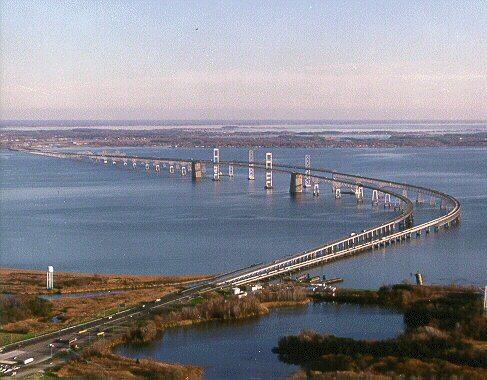
Chesapeake Bay Bridge

We are hopeful that this law will prove successful as it is implemented and a noticeable difference will be seen in the health of our local waterways and ultimately in the Chesapeake Bay.  The Bay is a valuable local resource and we need to do our part to ensure it remains beautiful and viable for the long run.

Posted in Stormwater Management | 1 Comment

Adorable Geese and Goslings = Possible Expensive Stormwater Repairs

Canadian Geese swimming in a pond and waddling along the shoreline are incredibly cute, especially when there have adorable, fuzzy, little goslings in tow.   But unfortunately they also cause damage to stormwater management facilities where they reside.  We frequently come across geese families during our inspections and have noted many of their effects.

Goose family going for a swim in a stormwater management facility.

The first problem results from the geese grazing on vegetation.  They graze on the short grass along the shoreline, often to the point where it looks like a fuzzy fake green deck carpet from the 1970’s.  This vegetation eventually dies and leaves the shoreline susceptible to any wave action and storm runoff.

Secondly, during their grazing activities, the geese walk up and down the embankments removing and trampling vegetation further adding to the shoreline erosion.

Third, the geese tend to deposit feces which accumulate around the facility.  Goose feces damage property, compromise overall quality of life, introduce bacteria into the receiving waters, and have the potential to pose serious health threats due to the presence of disease-causing organisms.  In short, they can turn a stormwater management pond into a point-source for pollutants.  AND, they can turn a nice walk around the pond into a shoe cleaning session!

Pollution issues aside, costs for damaged vegetation and shoreline erosion can easily run into the tens of thousands of dollars.  Quite a price to pay for giving birds a happy home.

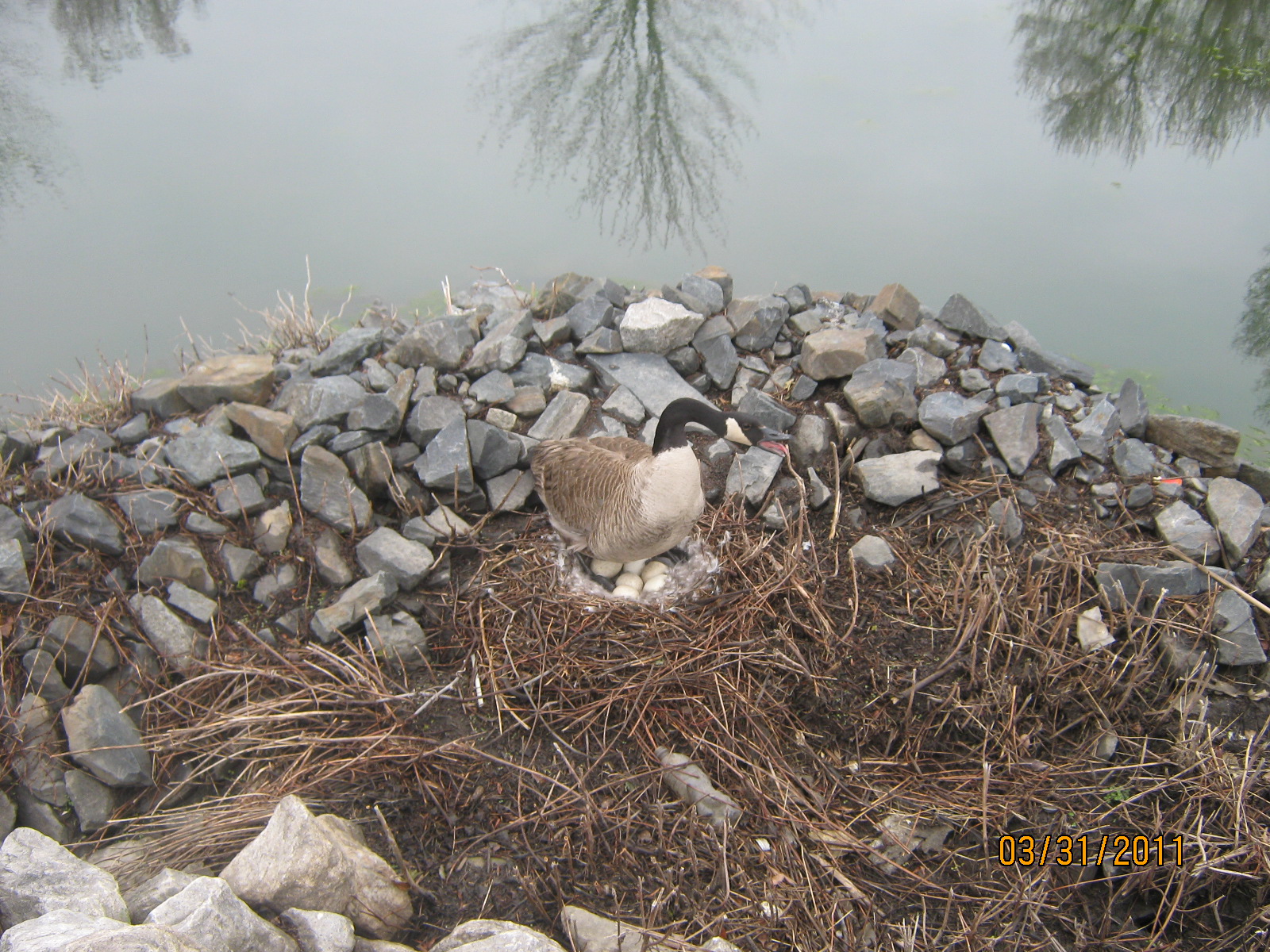
Angry goose protecting her nest encountered during an inspection.

Fortunately, there are some methods to discouraging geese from nesting in your pond.  The first step is to discourage tenants and guests from feeding the geese.   If people continue to feed geese they will often remain despite other more expensive and time consuming efforts and frequently suffer from poor health due to nutritional deficiencies.

A second easy step is to direct your landscapers to stop maintaining the bottom foot or two of vegetation around the facility and encouraging woody vegetation to grow, which reduces the value of the habitat.   Geese are grazers, and prefer to feed on short grass in areas that are open and within sight of a body of water.  This will also prevent the geese from walking up and down the embankments resulting in damage to the embankment. This practice must be closely monitored on fill embankments to avoid the growth of extensive woody vegetation.

Other more expensive alternatives are available if the first two steps do not do the trick.  Some examples include using flagging attached to wooden stakes or helium filled balloons with decals resembling eyes to deter geese from sticking around.  Also harassment of the geese with pyrotechnics, propane cannons, trained dogs, horns, distress calls and other devices can be effective in deterring geese.  Feel free to leave comments with other suggestions.

Posted in Stormwater Management | 3 Comments

Where we will be – July 13

We will have a booth at the Maryland Clean Water Innovations Trade Show.  Come visit us!

Posted in Stormwater Management | Leave a comment

The sounds of a 120″ Underground Detention Facility….

Video from a recent inspection demonstrating the intense echos in underground pipe systems, especially larger diameter.  The take home message for anyone doing this type of work is the difficulty the echos pose when communicating with topside support.  Communication signals must be worked out in advance.   Do NOT try this “at home” unless you have the proper training and equipment.

Posted in Stormwater Management | Leave a comment

Where we will be: June 14, 2011

We will be at the Home Builders of Maryland 2011 Stormwater Management Workshop on Tuesday, June 14, 2011 at the Hilton in Pikesville, Maryland.  Come by and say hello at our Stormwater Maintenance, LLC booth.

Ted Scott will kick off the day with an Introduction to Environmental Site Design Presentation:

Later, he will kick off a panel discussion of ESD Maintenance with a Prezi:

It should prove to be a worthwhile morning with representatives from the home building, engineering, construction, and municipality communities all gathered to reflect on the first year of Environmental Site Design in Maryland.

Posted in Stormwater Management | Tagged | Leave a comment

ROVVER Camera Inspections

Stormwater inspections are an important service which we offer our clients.  These inspections provide clients with a report detailing the condition of their stormwater facilities and recommendations.  The report is for the client’s use only and is not a regulatory tool.  The client is then able to assess what work needs to be done as well as schedule and budget for future improvements without the pressure of a violation letter.  In many cases stormwater management systems are located above ground or have an access point to enter and do a visual inspection.  However,  some systems are not easily accessible and are more difficult to diagnose when a problem exists.  This is especially important in pipe systems that are too small for confined space entry and with limited manhole access.

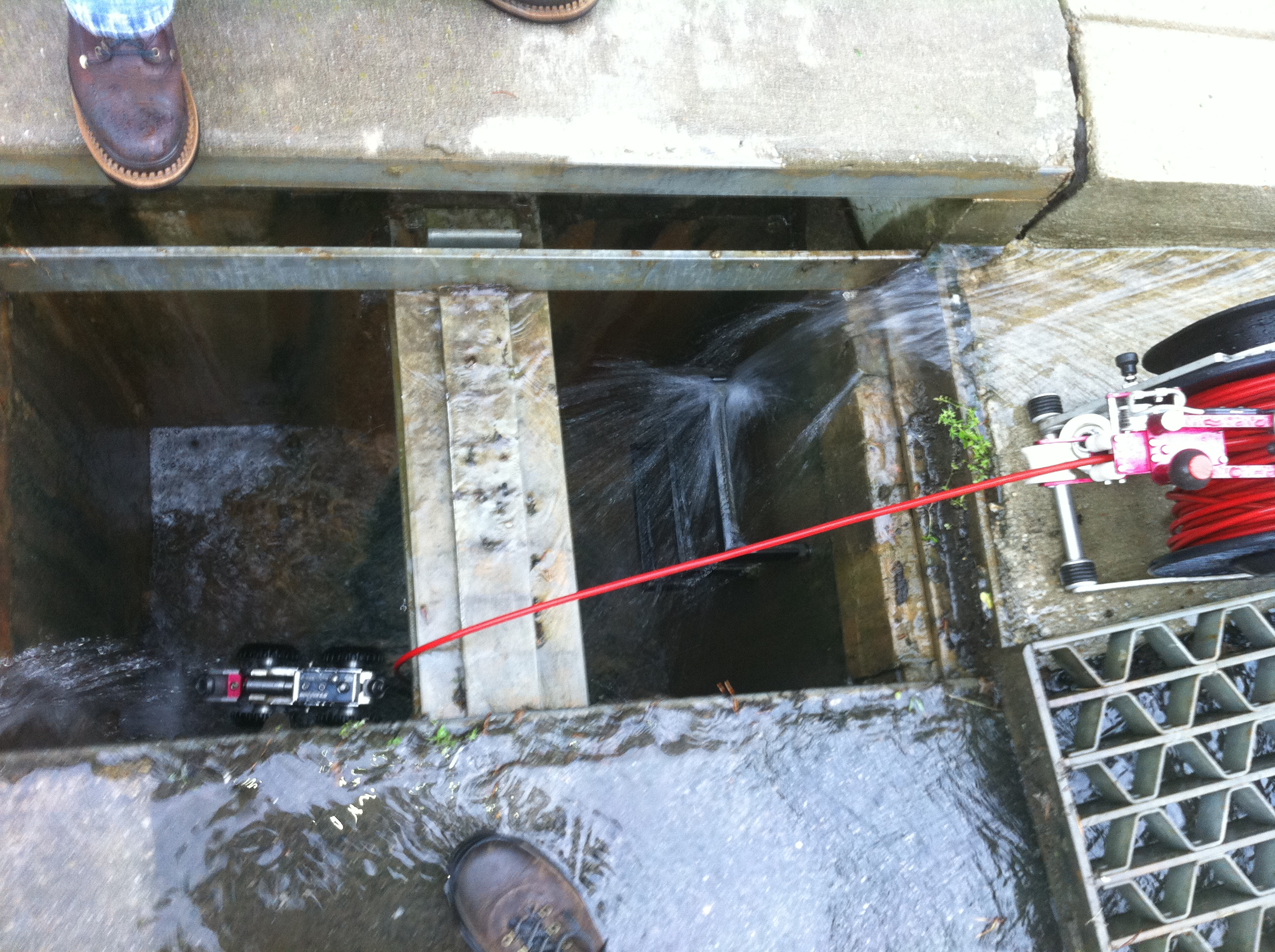
ROVVER camera inside storm drain inlet.

While digging up entire runs of pipe to find a blockage, misalignment, deterioration or deformation in the line may be effective, it is expensive and a huge disturbance to the site.  Luckily, we are able to avoid such invasive measures with a camera technology that gives us a set of eyes inside a pipe without causing any physical disturbance.

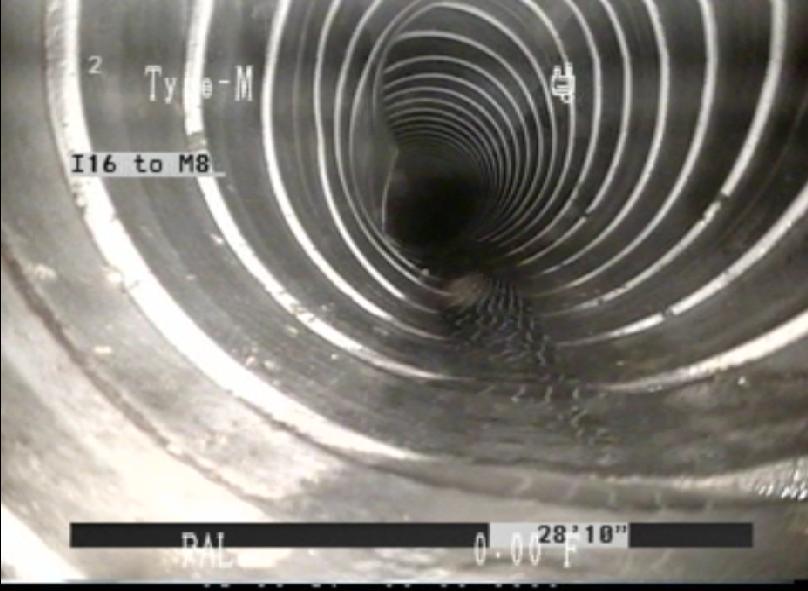
Damage to storm drain pipe as seen with ROVVER camera.

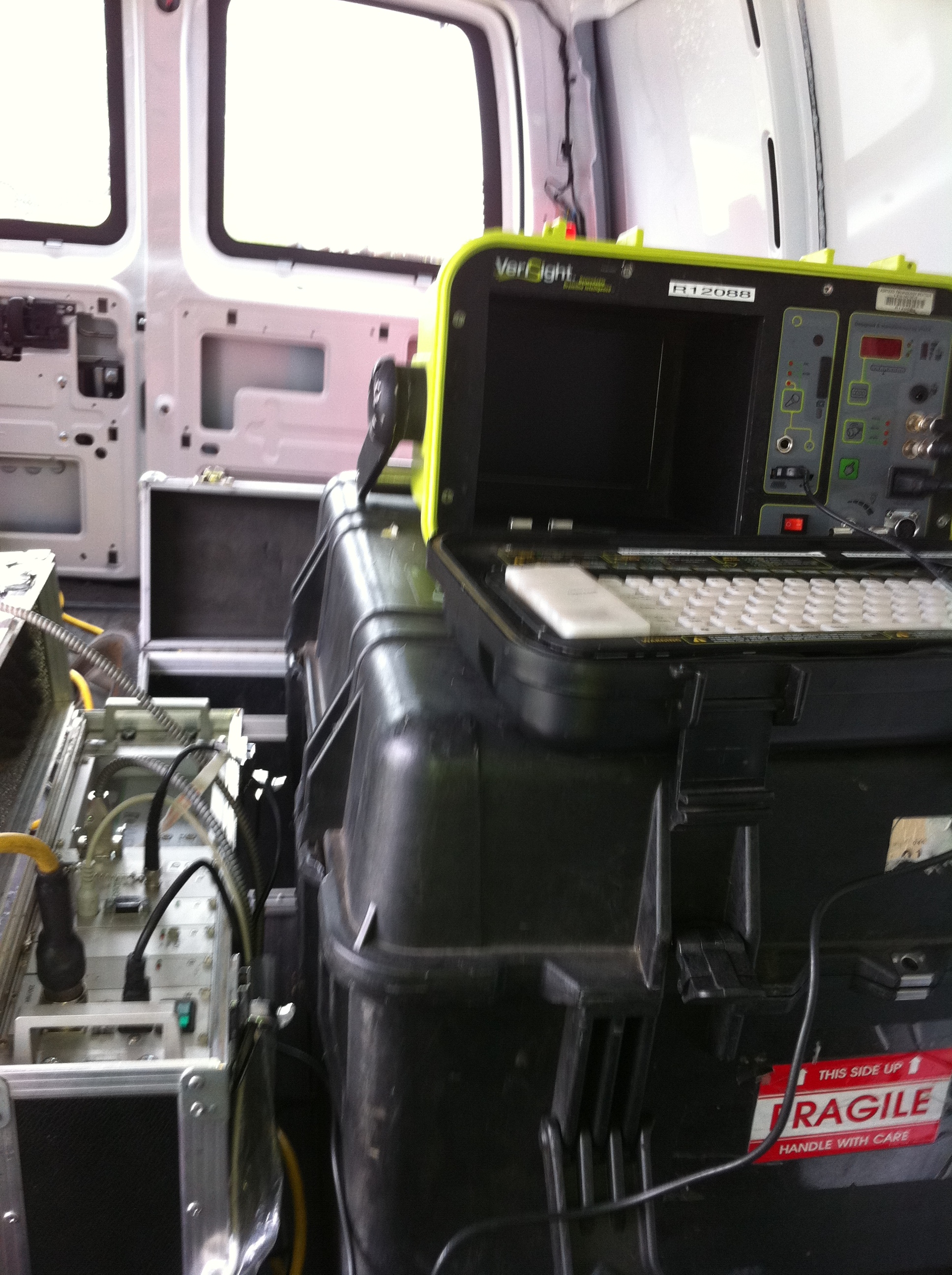
ROVVER camera set up on-site.

We are able to use a tiny robot camera to access deep inside of storm pipes and previously inaccessible storm drain systems.  This robot, called a ROVVER (short for Robotically Operated Video Vehicle Enhanced Receiver), can take video and still pictures while recording its position within the system. Knowing where the ROVVER is positioned within the pipe allows us to pinpoint the problem and design and implement a repair with less disturbance and lower costs.

The results are not very exciting to watch, but it gives us an excellent way to observe the condition of the pipe and joints, and how to design an effective repair if it is needed.  So grab a drink, kick back, and join us for five minutes of excitement deep underground in a corrugated metal pipe:

Posted in Stormwater Management | Leave a comment

Applied Stormwater is now a provider for grant recipients in the Chesapeake Bay Stewardship Fund Technical Assistance Program

We are really excited to announce our selection as a technical assistance provider for grant recipients through the National Fish and Wildlife Federation under the Chesapeake Bay Stewardship Fund Technical Assistance Program.  The program is a partnership with Chesapeake NEMO (Network for Eduction of Municipal Officials) and the National Park Service Chesapeake Bay Office.

We will be providing technical assistance in the field of stormwater management design and construction to those acting locally in the Chesapeake Bay Watershed to help improve the quality and quantity of stormwater discharged into the Bay.

This program parallels our interests to improve the Chesapeake Bay through implementation of low impact design and creative retrofits.  Applied Stormwater provides design, engineering, and landscape architecture services through T.E. Scott & Associates, Inc. and construction through Stormwater Maintenance, LLC.  Together, we provide comprehensive design-permitting-construction packages for stormwater and wetlands related retrofit projects.

We look forward to the opportunity to be involved with new and interesting projects!

Posted in Stormwater Management | Leave a comment

One of those job hazards …

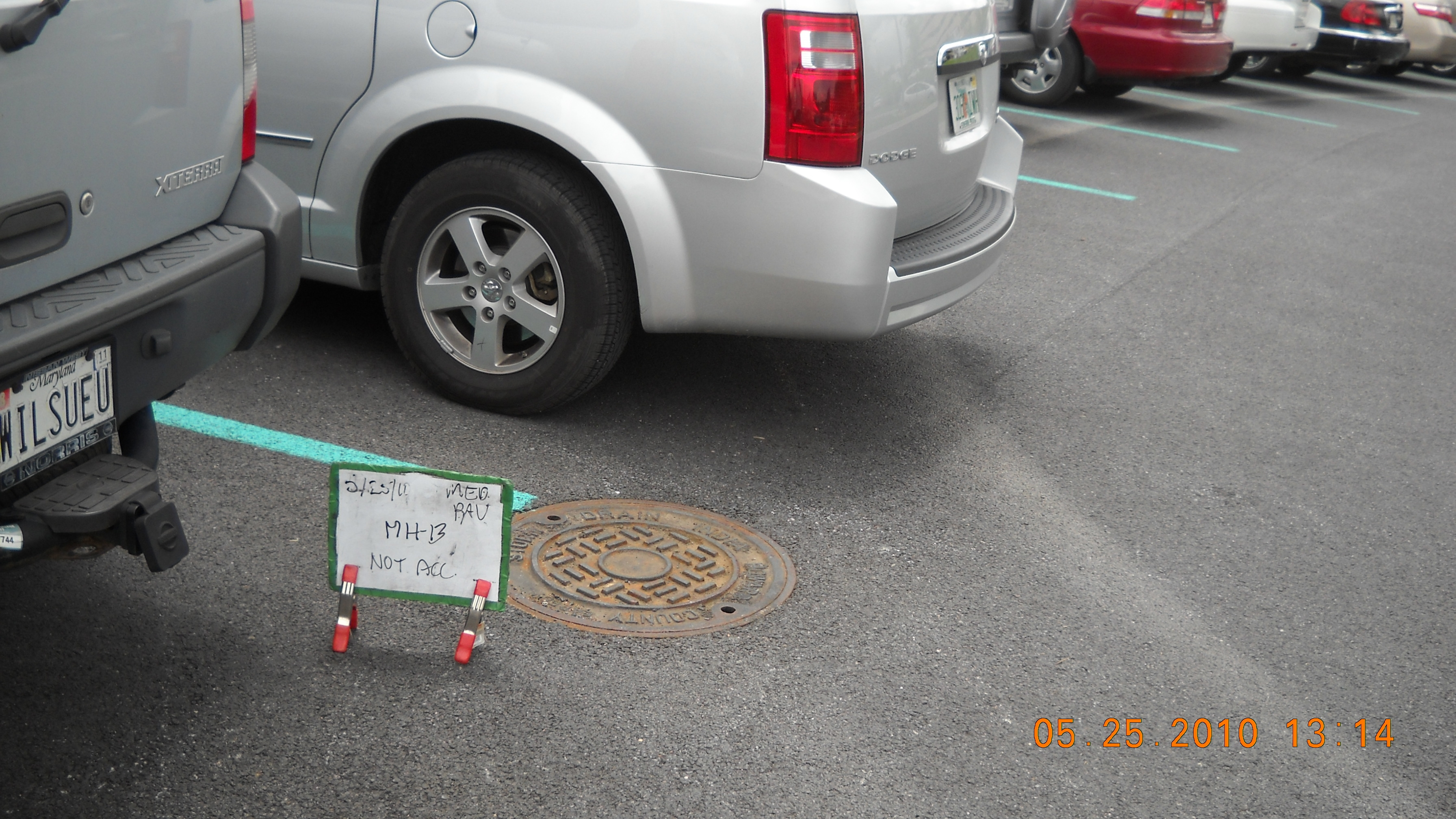
Typically, we open up all manholes and inlets during site inspections, but once in a while it seems like a better idea to just leave them alone.  The license plate on the vehicle next to the manhole pretty much sums it all up!  

I’m staying far away from this car!
Posted in Other Interesting Stuff, Stormwater Management, SWM Maintenance | Tagged | Leave a comment

Maryland Bag Bill

The State of Maryland is trying to pass a new bill, House Bill 1034, also known as the Clean the Streams and Beautify the Bay Act of 2011, which would take a huge step to clean up a major form of pollution around the state.  One of the biggest culprits polluting our waterways is plastic bags.  99% of all plastic bags in the U.S. are not being reused!

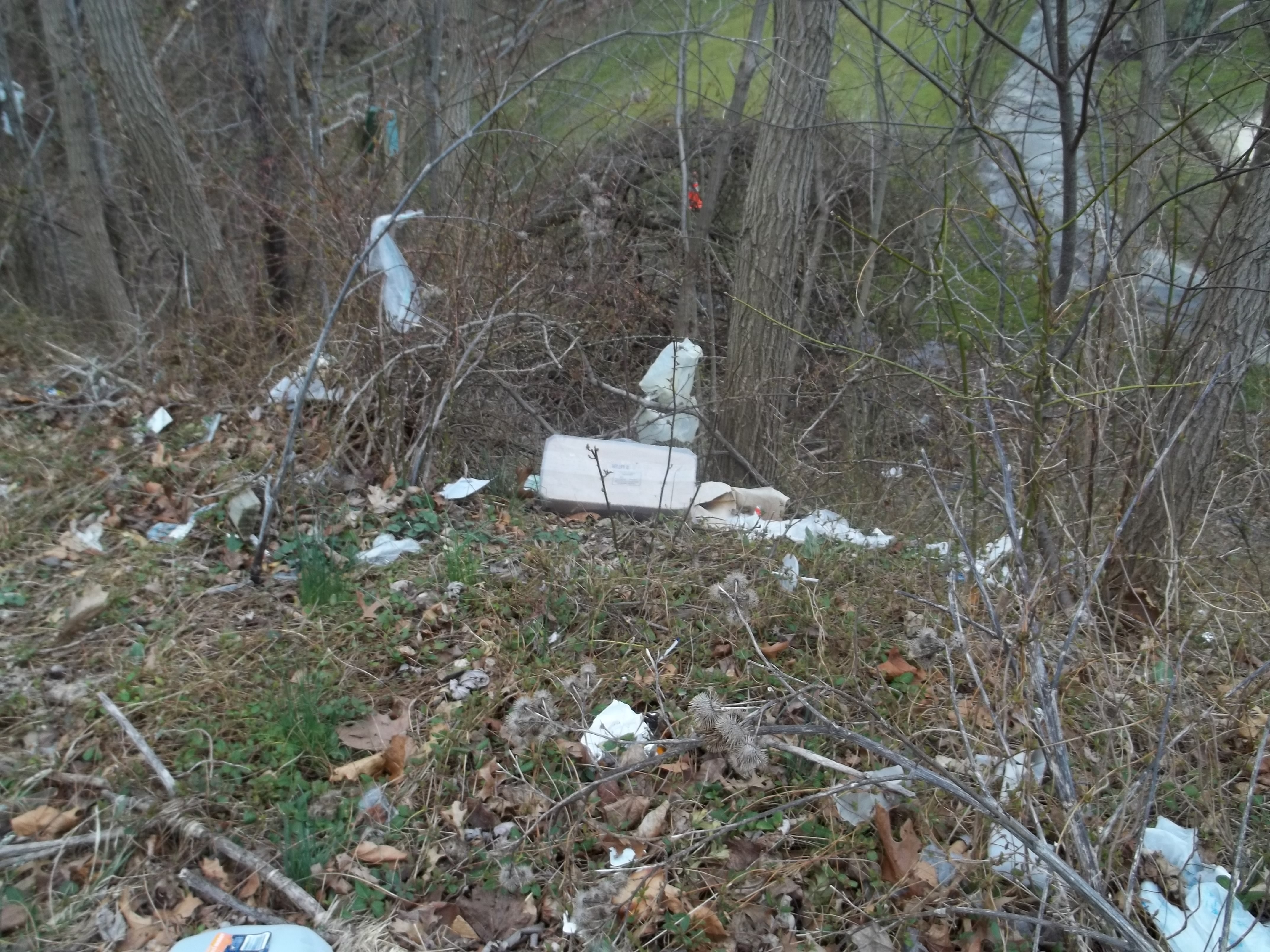
Trash seen on embankment of stormwater management facility at local shopping center.

This bill will prohibit a store from providing disposable carryout  bags unless the bags meet specified requirements; requires a store to charge and collect a fee for each disposable carryout  bag the store provides to a customer; requires the operator of a store to remit a specified amount of money to the Comptroller; and requires the Comptroller to distribute specified amount of money to the Department of Labor, Licensing, and Regulation, Chesapeake Bay Trust, and Department of Human Resources for specified purposes.

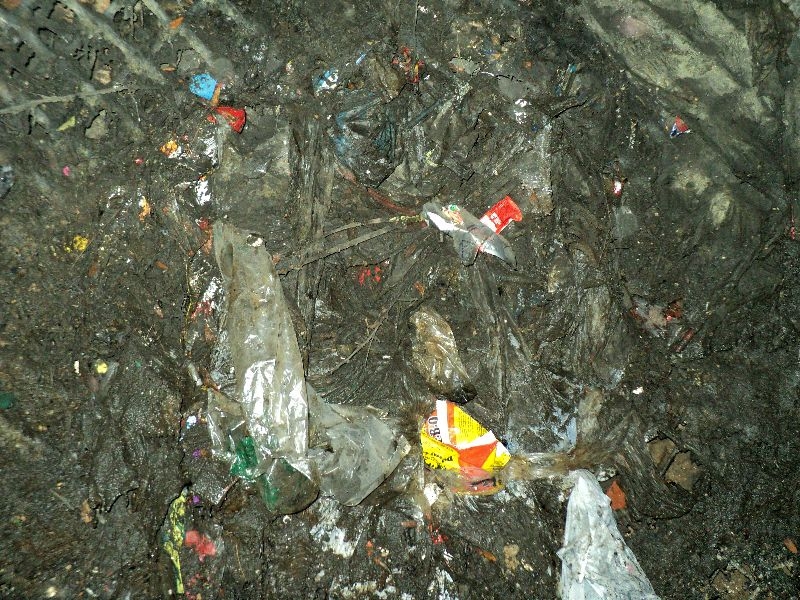
Bags captured in storm drain inlet.

This bill has already been passed by our neighbors in Washington, D.C.  In DC prior to this bill, 22.5 million single use bags were given monthly, whereas in January 2010 after implementation of the bag bill, only 3 millions bags were used, an 86% reduction!

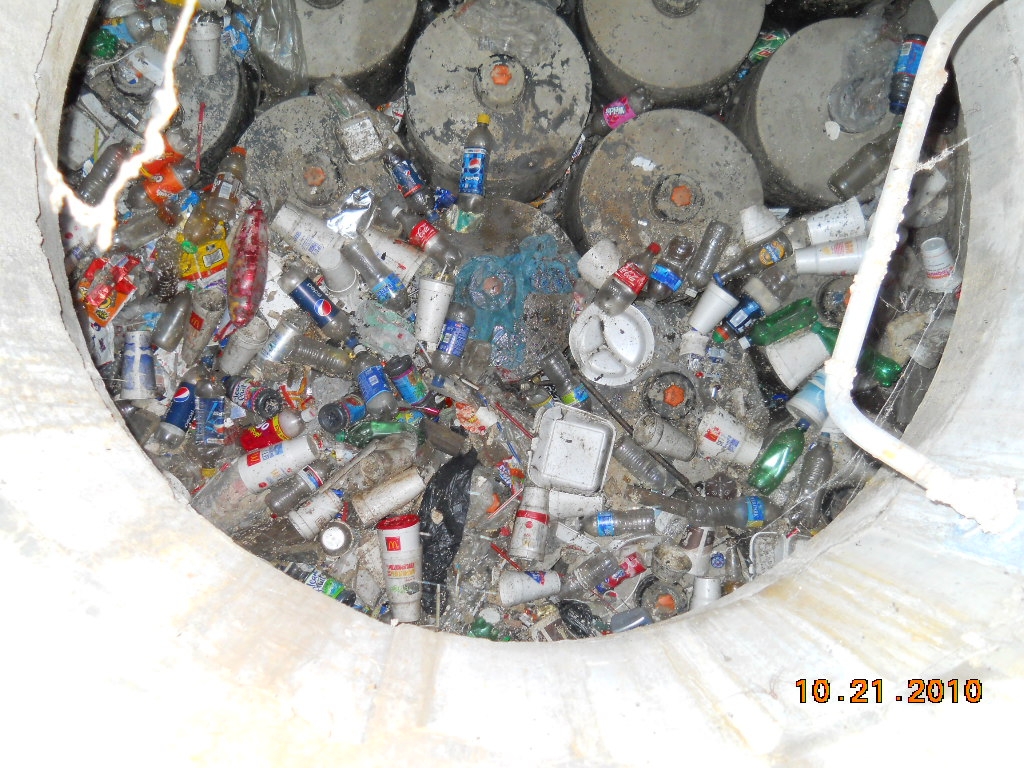
Unfortunately, we see lots of plastic bag pollution during our inspections and maintenance.  Many parking lots are full of discarded plastic bags and bottles which find their way into the stormwater management system.  These sites have inlets stuffed with trash and plastic and often the stormwater facilities are littered with bags and other trash.

Pastic bags and bottles in Stormfilter seen during a site inspection.

Ultimately a lot of this trash finds it way to the ocean.  Some of your plastic trash may even be floating in the Pacific or Atlantic garbage patches, that have been the topic of other posts here.

Some interesting facts about plastic bags:

  • Every year, around 5 billions plastic bags are used worldwide.
  • Over 1 million plastic bags are being used every minute!
  • Every man, woman and child on our planet uses 83 plastic bags every year.
  • Plastic bags are difficult and costly to recycle and most end up on landfill sites where they take around 300 years to photodegrade.
  • They break down into tiny toxic particles that contaminate the soils and waterways and enter the food chain when animals accidentally ingest them.
  • Plastic bags are now amongst the top 12 items of debris most often found along coastlines.

Clearly, we support this legislative initiative as it will dramatically reduce the pollution we see in our work every day.

Posted in Stormwater Management | Leave a comment

Come Visit Us at the NFMT Trade Show!

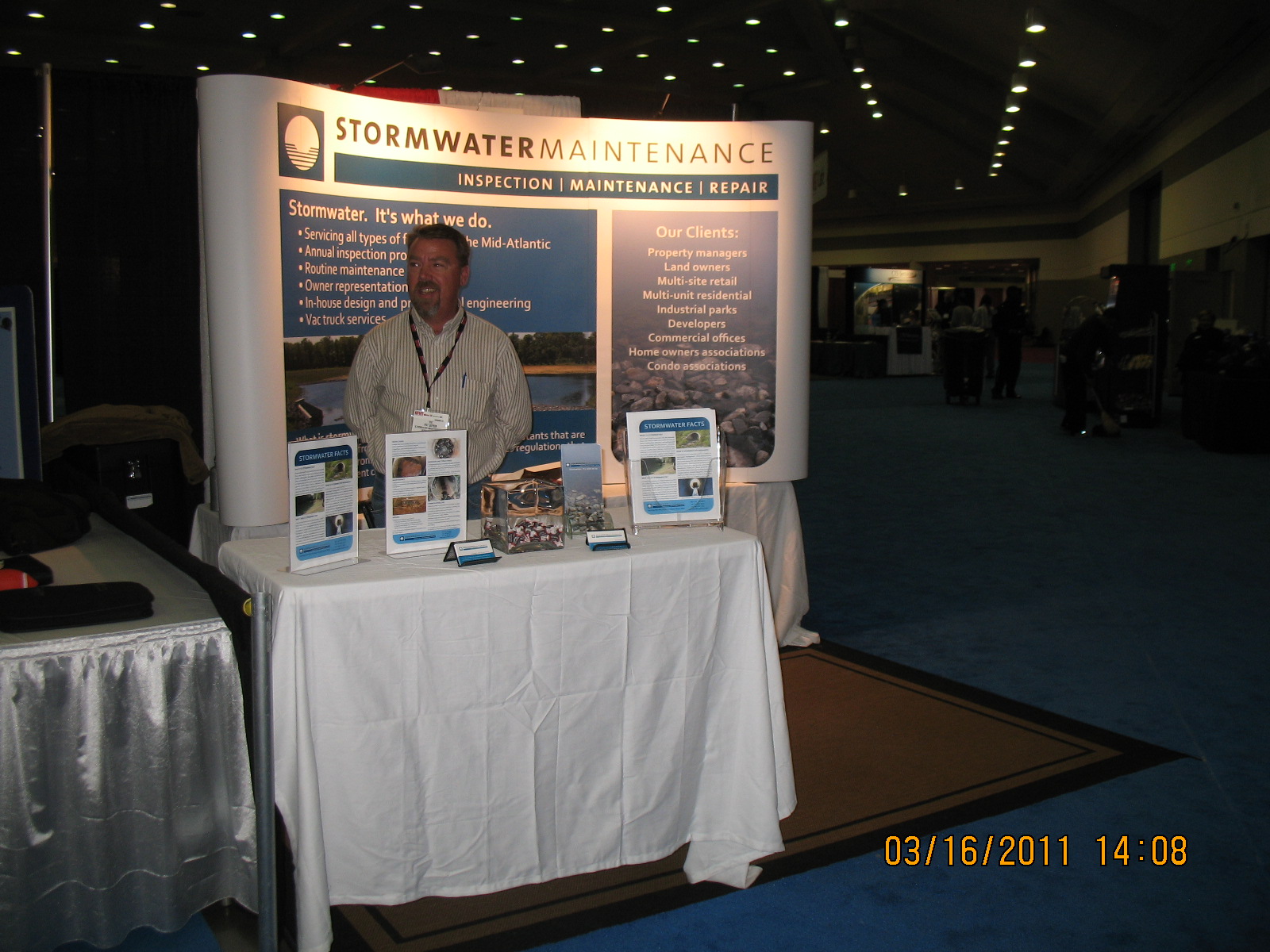
We’re excited to leave our cozy office and head down to the big city of Baltimore for the National Facilities Management and Technology (NFMT) Conference and Expo.  Stormwater Maintenance, LLC  is set up in Booth 1434 across from the food area inside the Baltimore Convention Center.  If you are in the area, come visit tomorrow from 11-2 pm and pick up a copy of our Stormwater Facts Sheet.

Pat Depkin, Stormwater Inspector Extraordinaire, manning our booth.

The exhibitors includes solutions for all your facilities maintenance needs including: access control and security; ADA; building automation; carpet and carpet care; diagnostic, monitoring and testing instrucments; doors and door hardware; energy management; restroom/plumbing; roofing; and sustainable solutions/LEED products.

In the building services pavilion you will also find firms that provide total facility management, contract cleaning, building construction services, energy services, HVAC maintenance, pest control, landscaping, snow removal … and most importantly (at least in our opinion) … STORMWATER MAINTENANCE!!!

Posted in Stormwater Management | Leave a comment