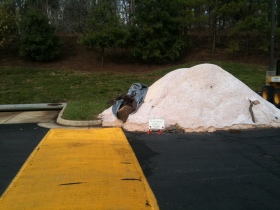
 After a winter as harsh as the one we’ve just experienced, one question lingering in our minds is, what is the environmental impact of all that road salt?
Maryland’s State Highway Administration reports using 480,000 tons of salt this past winter. The average for the previous 6 years is about 211,000 tons.
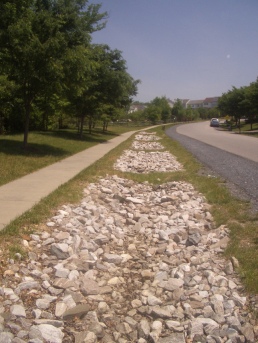
As snow melts, it carries road salt into waterways that are normally fresh water. Salt laden snowmelt can flow directly into streams, or partially infiltrate into the ground via roadside stormwater facilities. Streams are fed by groundwater that flows to the surface. According to a report by Maryland’s Department of Natural Resources (DNR), some plants and animals can tolerate the spikes in salinity levels that follow a snowfall event, and others cannot. (Several other sources are also referenced – see below.)
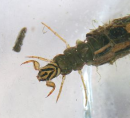 Near the bottom of the food chain, mayflies, stoneflies, and caddisflies are particularly sensitive to changes in salinity. These insects are an important food source for birds and fish. Brook trout is noted as a fish species found in Maryland streams most sensitive to changes in salinity. Many types of amphibians, such as frogs and salamanders, are affected by increased salinity, especially those that lay eggs near the bottom of ponds where salt concentrations are highest.
Studies show that birds that ingest salt crystals can die within 45 minutes. Salt can also be fatal to other small animals, such as rodents, that eat leaves coated in salt dust, or breathe it in.
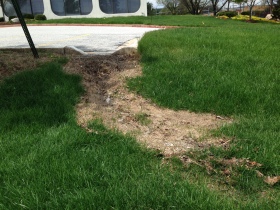 Roadside grasses and other vegetation can be killed off by road salt. These plants are important for preventing soil erosion. All types of vegetation, even trees, can be killed off, or at least weakened, by road salt when they are coated in it due to spray from traffic, or by taking up salty snowmelt through their roots.
Studies also show that road salt increases salinity in our drinking water reservoirs. Measurements of salinity in reservoirs going back to the 1980s show a steady increase over the past few decades.
Removing ice and snow from roadways is important for creating safer driving conditions during and after snowfall events, so, do any alternatives to salt even exist?
Sand can help with traction and it is already often mixed with road salt, but used by itself it does not melt ice. Calcium magnesium acetate is one alternative, however it is expensive and could also have negative ecological impacts. 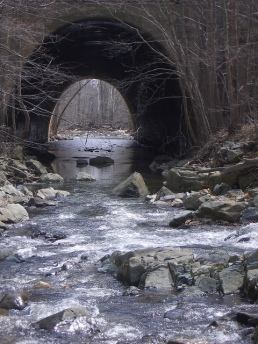 Beet juice has been used as a more natural, biodegradable de-icer, however it also costs more than salt and it ma
y not have been as effective. Cheese brine has also been used, and while it is a good idea to find uses for manufacturing by-products, its ecological impacts are unstudied, and therefore unknown. MDE’s web page, “411 on Road Salt” says that Maryland’s SHA has been experimenting with all of these alternatives as well as finding ways to reduce the amount of salt they use.
One piece of good news is that pretreating roads with salt brine, a relatively new practice, can reduce the use of salt in multiple ways. Brine can’t be blown away by wind or bounced off the road by traffic, so waste is reduced. This pre-treatment also begins to melt snow as soon as snowflakes touch the road, which makes it more efficient, resulting in less salt needed throughout a snowfall event.
For further reading, see the resources used for this blog post:
Stranko, Scott, Rebecca Bourquin, Jenny Zimmerman, Michael Kashiwagi, Margaret McGinty, and Ron Klauda. Do Road Salts Cause Environmental Impacts? Rep. N.p.: Maryland Department of Natural Resources, 2013.
Siegel, Lori, Ph.D., PE. Hazard Identification for Human and Ecological Effects of Sodium Chloride Road Salt. Rep. N.p.: New Hampshire Department of Environmental Resources, 2007.
Pomeroy, Courtney. “Harsh Winter Doubles Normal Md. Road Salt Use, Sparking Environmentalist Concern.” CBSLocal. CBS DC, 13 Mar. 2014. Web. 04 Apr. 2014. <http://washington.cbslocal.com/2014/03/13/harsh-winter-doubles-normal-md-road-salt-use-sparking-environmentalist-concern/>.
Montero, Jorge. “A Briny Challenge to Cleaning the River.” Web log post. AWS Blog. Anacostia Watershed Society, 18 Feb. 2014. Web. 4 Apr. 2014. <http://www.anacostiaws.org/news/blog/briny-challenge-cleaning-river>.
“The 411 on Road Salt.” The 411 on Road Salt. Maryland Department of the Environment, n.d. Web. 04 Apr. 2014. <http://www.mde.state.md.us/programs/Marylander/Pages/roadSalt.aspx>.




 8. Even though we do not have a




 Sustainable Stormwater Management